Body Mass Index (BMI) Percentiles for Boys, 2 to 20 Years
This is easy to use - no data input required. Find your child's BMI percentile in the chart based on height and weight.
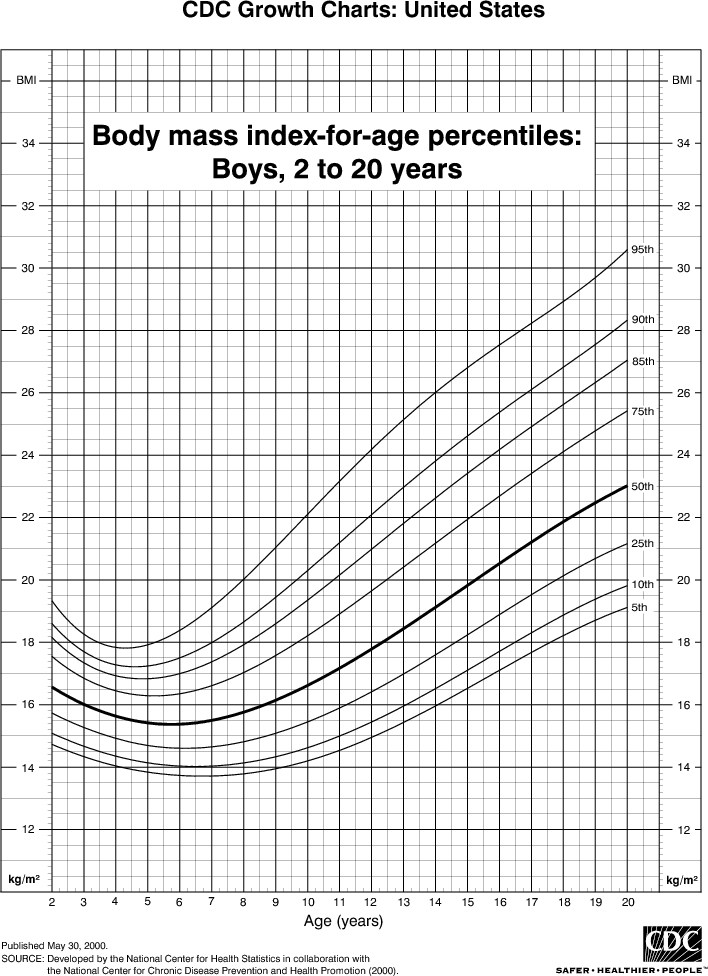
This chart shows the Body Mass Index (BMI) percentiles for boys from 2 to 20 years old.
How to read the chart
The curved lines show BMI percentiles. For example, the top curved line shows the 95th percentile, which means that 95% of children are at or under that value.
The bottom of the chart shows ages, from 2 to 20 years. The left and right sides of the chart show BMI values.
The chart shows that at age 2 years 95% of boys have a BMI less than 19.4 and 5% have one less than 14.6. At 20 years 95% of boys have a BMI less than 30.6, and 5% have one less than 19.
How to find your child's BMI percentile
First, find your child's BMI in BMI for Children.
Then on this page, find your child's BMI on either side of the chart, and read horizontally across until you reach the vertical line for your child's age. Then see where that point is among the percentile lines.
For example, a boy with a BMI of 18 at age 12 is just above the 50th percentile.
Weight status for children
The BMI for children is calculated the same way as for adults. However, it is interpreted differently. The CDC uses these weight status categories for children and teens:
| BMI percentile | Weight status |
|---|---|
| Less than the 5th percentile | Underweight |
| 5th to less than the 85th percentile | Healthy weight |
| 85th to less than the 95th percentile | Overweight |
| 95th percentile or greater | Obesity |
The CDC also uses "severe obesity" for a BMI at or above 120% of the 95th percentile. See the CDC's child and teen BMI categories.
Consult your doctor if you are concerned about your child's growth.
About this chart
The chart comes from the Centers for Disease Control and Prevention's National Center for Health Statistics. We converted it from the CDC's PDF into a web image. Print the PDF version if you'd like to record your child's measurements.